ISU Mathematics Department

Objectives for Calculus I

Limits

  • Use graphical and numerical evidence to estimate limits and identify situations where limits fail to exist.
  • Apply rules to calculate limits.
  • Use the limit concept to determine where a function is continuous.

Derivatives

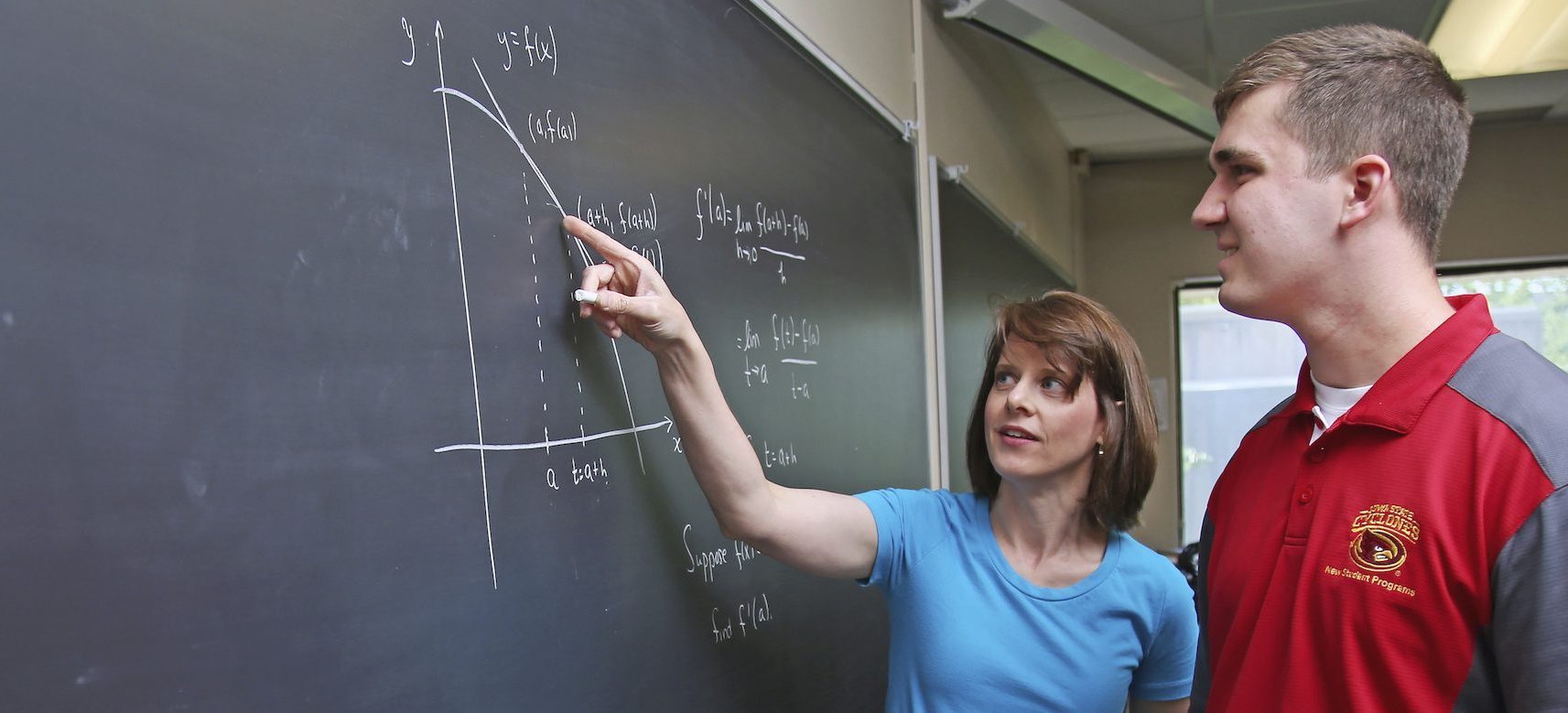
  • Use the limit definition to calculate a derivative, or to determine when a derivative fails to exist.
  • Calculate derivatives (of first and higher orders) with pencil and paper, without calculator or computer algebra software, using:
    • Linearity of the derivative;
    • Rules for products and quotients and the Chain Rule;
    • Rules for constants, powers, trigonometric and inverse trignometric functions, and for logarithms and exponentials.
  • Use the derivative to find tangent lines to curves.
  • Calculate derivatives of functions defined implicitly.
  • Interpret the derivative as a rate of change.
  • Solve problems involving rates of change of variables subject to a functional relationship.

Applications of the Derivative

  • Find critical points, and use them to locate maxima and minima.
  • Use critical points and signs of first and second derivatives to sketch graphs of functions:
    • Use the first derivative to find intervals where a function is increasing or decreasing.
    • Use the second derivative to determine concavity and find inflection points.
    • Apply the first and second derivative tests to classify critical points.
  • Use Differential Calculus to solve optimization problems.

The Integral

  • Find antiderivatives of functions; apply antiderivatives to solve separable first-order differential equations.
  • Use the definition to calculate a definite integral as a limit of approximating sums.
  • Apply the Fundamental Theorem of Calculus to evaluate definite integrals and to differentiate functions defined as integrals.
  • Calculate elementary integrals with pencil and paper, without calculator or computer algebra software, using:
    • Linearity of the integral;
    • Rules for powers (including exponent -1) and exponentials, the six trigonometric functions and the inverse sine, tangent and secant;
    • Simple substitution.

Transcendental Functions

  • Use the relation between the derivative of a one to one function and the derivative of its inverse.
  • Calculate with exponentials and logarithms to any base.
  • Calculate derivatives of logarithmic, exponential and inverse trigonometric functions. Use logarithmic differentiation.
  • Use models describing exponential growth and decay.